
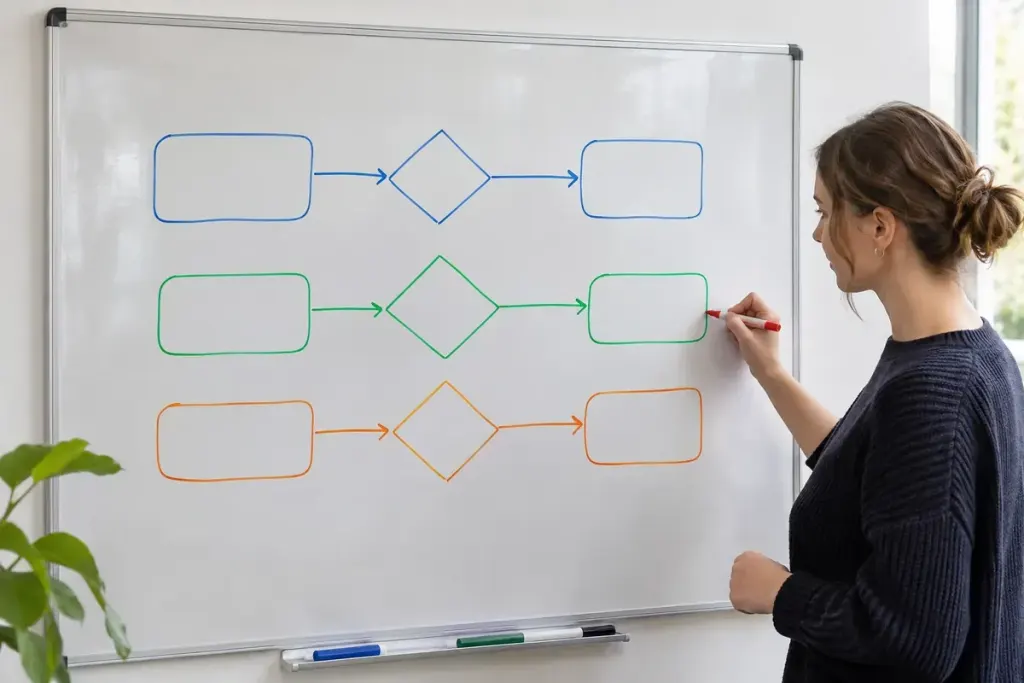
A task can be complete for one team and still be unusable to the next. Sales has accepted the order, operations is waiting for a specification and finance has not received the billing details. A list of departmental tasks may look complete while the handoffs remain invisible.
A swimlane map puts the sequence and responsibility in the same picture. Each lane represents a role or team; the work moves between lanes as responsibility changes.
Map one real case
Microsoft’s explanation of cross-functional flowcharts describes a grid showing who does what and when. You can use that principle on paper without buying a diagramming tool.
Choose a recent, ordinary example rather than an ideal future process. Draw three or four lanes and put each action in the lane of the person who actually performed it. Add the decision points and the places where work waited.
Give each crossing a condition
In an illustrative order process, “send to operations” is too vague. The handoff might require an agreed specification, delivery address and approval of an exception. If those items are missing, the next team has not received a usable package even if an email was sent.
At each crossing, ask:
- What exactly is being handed over?
- How does the receiving team know it is ready?
- Who can reject or return incomplete work?
- Where does the case wait while a question is answered?
Include the return path. A diagram that shows only successful forward motion may conceal the loop that consumes most of the team’s time.
Use the map to improve one boundary
Do not begin by redesigning every role. Pick one repeated handoff problem and agree a small change, such as a shared readiness checklist or a named route for exceptions. Then observe whether it reduces rework in actual cases.
Keep the people doing the work involved in the map. A process drawn only by managers can miss informal fixes that currently keep it functioning. The diagram is most useful when someone can point to an arrow and say, “This is where we need a clearer agreement,” rather than merely admire how orderly the boxes look.