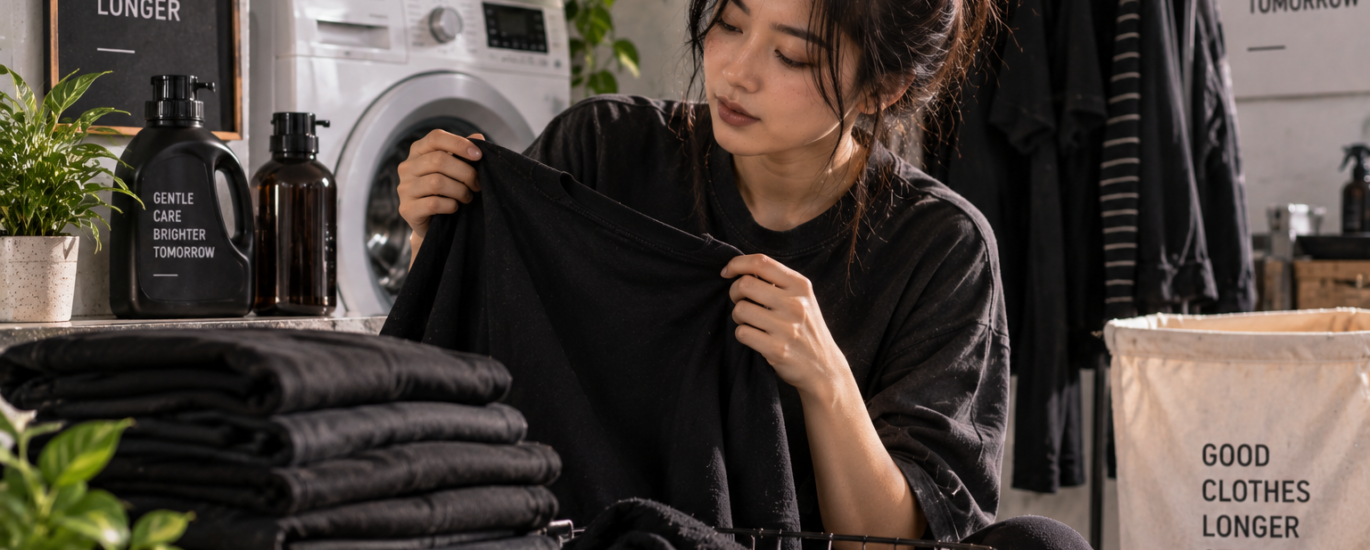
Your Black Clothes Looked Perfect When You Bought Them—So Why Are They Already Fading?
A new black T-shirt can look almost impossibly clean.
The color is deep, the fabric looks smooth, and even a simple outfit feels sharper because the black appears rich and consistent. Then the shirt goes through the laundry several times.
Suddenly, it looks different.
The seams seem lighter. The surface has a slightly gray cast. Areas that experience more rubbing no longer match the rest of the garment, and the black jeans that once looked almost new beside everything else in your closet now seem noticeably washed out.
Learning how to keep black clothes from fading starts with understanding that dark clothing is constantly exposed to friction, water, detergent, heat, and light. You may not be able to keep every garment looking factory-new forever, but small changes in how you wash, dry, and wear it can slow visible fading.
Black Fabric Is Not Naturally “Black Forever”
The color you see on a garment depends on dyes or pigments interacting with textile fibers.
Different fabrics use different dyeing processes, and not every black garment begins with exactly the same chemistry. Cotton, polyester, wool, denim, and blended fabrics can therefore age differently.
Even two black T-shirts purchased from different brands may not fade in the same way.
Fabric construction, dye quality, finishing processes, laundering, and everyday wear all influence how long the original appearance lasts.
This is why care instructions matter more than assuming every dark garment can be treated identically.
Fading Is Often More Visible on Dark Clothing
A small color change on a pale beige shirt may barely attract attention.
The same degree of change on deep black fabric can be obvious.
Black creates strong visual contrast, so areas that become slightly lighter stand out quickly. Seams, edges, knees, elbows, pockets, and other high-friction areas may show the change first.
This can make black clothing seem unusually fragile.
In reality, part of the issue is simply visibility: changes that might be subtle on another color are much easier to notice against a very dark surface.
Washing Creates Mechanical Friction
Inside a washing machine, garments do not simply soak peacefully in water.
They move.
Fabric rubs against fabric. Sleeves twist around other garments. Zippers, buttons, seams, and textured materials can repeatedly contact surrounding surfaces.
Over time, this mechanical action can alter the surface of the fabric and contribute to a faded appearance.
That does not mean black clothing should never enter a washing machine. It means reducing unnecessary abrasion can help preserve its appearance.
Turn Dark Clothes Inside Out Before Washing
One of the simplest habits is turning black and dark garments inside out.
This does not create an impenetrable shield around the fabric.
However, it places the inner surface in more direct contact with much of the mechanical action during washing, helping reduce some abrasion on the visible exterior.
The technique is particularly practical for items such as T-shirts, hoodies, jeans, and casual dark clothing.
It takes only a few seconds and does not require buying another laundry product.
Wash Clothes Because They Need Washing, Not Automatically
Every wash cycle adds some amount of wear.
That does not mean avoiding hygiene or repeatedly wearing genuinely dirty clothing.
But not every garment necessarily needs to be washed after the same amount of use.
A shirt worn during a hot day may clearly need laundering. A dark outer layer worn briefly over clean clothing might not.
Follow hygiene needs, fabric requirements, and the garment’s care instructions rather than automatically throwing everything into the laundry basket after minimal wear.
Fewer unnecessary wash cycles mean fewer opportunities for fading and fabric wear.
Cold Water Is Often Friendlier to Dark Clothing
For many everyday dark garments, cooler water can be a useful choice when permitted by the care label.
High temperatures can be harder on certain fibers, finishes, and dyes.
Cold or cool water also uses less energy for heating, which can be an additional practical benefit.
However, the care label remains important.
Some garments have specific cleaning requirements, and situations involving sanitation or particular stains may require a different approach.
The goal is not to declare that cold water is universally mandatory. It is to avoid using unnecessary heat simply because the machine defaults to it.
More Detergent Does Not Mean Cleaner Clothes
It is easy to assume that an extra amount of detergent will produce an extra-clean result.
Laundry does not work that simply.
Using more detergent than necessary can make rinsing more difficult and may leave residue depending on the machine, water conditions, and product.
Follow the detergent manufacturer’s dosing instructions and consider load size and water hardness where relevant.
Black clothing should come out clean—not coated in an unnecessary amount of cleaning product.
Detergent Choice Can Matter
Some laundry products are marketed specifically for dark clothing.
Their formulations vary, so marketing alone should not be treated as proof that every “dark wash” product will dramatically extend garment life.
Still, detergent chemistry can influence how textiles and dyes behave during repeated laundering.
Use products appropriate for the fabric and washing method, and avoid assuming stronger cleaning action is always better for color preservation.
For normal everyday wear, aggressive treatment may create more wear than the garment actually needs.
Separate Dark Clothes Thoughtfully
Sorting laundry is not only about preventing a red sock from turning white clothing pink.
It can also help control abrasion and lint.
Washing a lightweight black T-shirt with rough towels, heavy denim, and garments covered in hardware creates a different mechanical environment than washing it with similarly weighted dark clothing.
Grouping compatible fabrics can reduce unnecessary friction.
You do not need twenty different laundry categories.
A little common sense about color, weight, texture, and care requirements can make a meaningful difference.
Zippers and Hardware Can Be Rough on Other Garments
A metal zipper may seem harmless when clothing is sitting in a wardrobe.
Inside a moving washing machine, it becomes a hard object repeatedly contacting fabric.
Close or secure garment fasteners according to the item’s care needs and avoid mixing delicate dark clothing with items that can aggressively rub or snag it.
Also check pockets.
Keys, coins, and other forgotten objects do not belong in a wash cycle and can damage both clothing and equipment.
Protecting color often begins with protecting the textile surface itself.
Overloading the Machine Is Not a Shortcut
A washing machine needs enough space for clothing and water to move appropriately according to its design.
Stuffing the drum excessively can reduce washing and rinsing performance.
At the same time, packing garments tightly together can create an environment where clothing rubs and twists under pressure.
Follow the machine manufacturer’s recommended capacity.
Doing one enormous overloaded load is not necessarily gentler—or more efficient—than washing an appropriate amount properly.
The Dryer Can Accelerate Visible Aging
Washing gets most of the blame for faded clothing, but drying deserves attention too.
Tumble dryers expose garments to heat and mechanical movement.
For items that tolerate machine drying, using appropriate settings matters.
Excessive heat can affect certain fibers, elastics, finishes, and garment shapes over time.
If preserving a particular dark item is a priority, air drying may be worth considering when the care label allows it.
Again, the objective is not to treat dryers as forbidden.
It is to avoid more heat and tumbling than the garment needs.
Direct Sunlight Can Fade Fabric Too
Air drying has an obvious advantage: less tumbling.
But placing dark clothing in strong direct sunlight for extended periods introduces another factor.
Ultraviolet radiation and light exposure can contribute to color fading in textiles.
This is not limited to laundry.
Clothing, upholstery, curtains, and other colored materials can change after repeated exposure to strong sunlight.
If you air dry dark garments, a shaded, well-ventilated area can help reduce intense direct UV exposure while still allowing moisture to evaporate.
Your Wardrobe Location Can Matter
A black jacket hanging beside a window may receive sunlight day after day.
You might not notice any change for months.
Eventually, the side consistently facing the window can begin to look different.
Long-term storage is therefore part of clothing care too.
Keep garments away from unnecessary prolonged direct sunlight, particularly items you want to preserve for years.
A wardrobe does more than organize clothing.
It also creates a more stable environment for it.
Deodorant Marks Can Make Black Clothing Look Faded
Sometimes the color has not actually disappeared.
Residue is sitting on top of it.
Deodorant, antiperspirant, detergent, body products, and minerals can leave pale marks that are extremely visible on black fabric.
Before assuming a garment has permanently faded, examine whether the lighter area looks like surface residue.
Clean it using a method appropriate for the textile and product involved.
Avoid aggressive scrubbing, which can create a real faded patch while trying to remove a temporary mark.
Repeated Friction Happens Outside the Washing Machine Too
Laundry is only one source of wear.
A backpack repeatedly rubbing against the same section of a black shirt can gradually change its surface.
The knees and seat of dark trousers experience friction during daily movement.
Bag straps, seat belts, desks, jackets, and even repeated contact from hands can affect particular areas.
This explains why some garments fade unevenly.
The entire item may have experienced the same number of washes, but not every section experienced the same life.
Black Jeans Are Supposed to Change
Dark denim deserves special attention because its appearance can evolve dramatically.
Depending on the denim and dyeing method, high-friction areas can gradually become lighter and develop visible wear patterns.
Some people dislike this and want black jeans to remain uniformly dark.
Others enjoy the way denim develops character over time.
Neither preference is inherently wrong.
The important part is recognizing that a garment designed around denim construction may not remain visually identical to a smooth synthetic black trouser.
Material changes expectations.
Fabric Type Changes the Care Strategy
A black cotton T-shirt, polyester sports top, wool sweater, and silk blouse should not automatically receive identical treatment.
Different fibers respond differently to moisture, heat, agitation, detergent, and drying.
This is why generic social-media laundry tricks can be risky.
A method that appears harmless on sturdy cotton may be inappropriate for wool or delicate fabrics.
The most reliable starting point is still the garment’s care label.
Then adjust everyday habits to minimize unnecessary wear within those instructions.
Be Careful with “Restore Black Clothes” Hacks
Online clothing advice often recommends household ingredients as universal fixes.
Salt.
Vinegar.
Coffee.
Various homemade mixtures.
Some techniques may have legitimate uses in particular textile processes, but pouring random ingredients into a home washing machine does not guarantee that faded dye will somehow return to the fiber.
A garment that has physically lost color is different from one covered in residue.
Before experimenting, understand what problem you are actually trying to solve.
Dyeing Can Restore Some Garments, but It Is a Separate Project
If a favorite black cotton garment has genuinely faded, re-dyeing may be an option.
However, successful dyeing depends heavily on fiber composition, stitching, existing finishes, stains, and the type of dye being used.
Synthetic fibers may require different dye chemistry from natural fibers.
Threads and trims may also take color differently.
Follow the dye manufacturer’s instructions carefully and consider whether the garment is worth the effort.
Re-dyeing is not ordinary laundry maintenance. It is a textile modification process.
Washing Less Aggressively Does Not Mean Washing Poorly
There is a tendency to equate powerful washing with good washing.
Hotter water.
Longer cycle.
More detergent.
More agitation.
For heavily soiled items, stronger cleaning may sometimes be appropriate.
But ordinary dark clothing worn in everyday situations may not require the most aggressive settings available.
Use enough cleaning action for the actual level of soil.
Anything beyond that can become additional textile wear without providing a meaningful benefit.
Treat Stains Locally When Appropriate
A small stain does not always require punishing the entire garment.
When appropriate for the fabric, targeted stain treatment can address the affected area before normal laundering.
Always check product compatibility and avoid rubbing dark fabric aggressively.
The wrong stain remover can also alter color.
Testing an inconspicuous area can be sensible for unfamiliar products or delicate garments.
The objective is to remove the stain without creating a new pale patch around it.
Buying Better Starts with Looking Beyond the Color
Two garments can look equally black under store lighting and age very differently.
Before buying, consider fabric composition, construction, intended use, and care requirements.
If you know you will never hand wash or dry clean something, buying a garment that requires that level of care may not be practical.
Likewise, a delicate dark fabric may be a poor choice for an activity involving constant friction.
A sustainable wardrobe is partly about choosing clothing compatible with the way you actually live.
A Slightly Faded Black Garment Is Not Automatically Ruined
Fashion often encourages the idea that clothing should look new indefinitely.
But garments are objects we live in.
They bend, rub, stretch, get washed, encounter sunlight, and develop signs of use.
A faded black tee can still work beautifully in a casual wardrobe. Washed black denim can create a completely different aesthetic from crisp jet-black jeans.
Care should extend the useful life of clothing, not create anxiety about every tiny visual change.
Sometimes fading becomes part of the garment’s character.
Know When Color Change Signals Actual Damage
Fading itself is primarily an appearance issue.
But if color change appears alongside thinning fabric, holes, damaged seams, severe stretching, or deteriorating fibers, the garment may have a broader wear problem.
Inspect high-friction areas periodically.
Catching a loose seam early is easier than repairing a large tear later.
Good clothing care is not just about preserving dye.
It is about keeping the entire garment functional.
Build a Simple Dark-Laundry Routine
You do not need a complicated ritual for how to keep black clothes from fading.
Check the care label.
Wash only when needed.
Turn suitable dark garments inside out.
Use an appropriate cycle and water temperature.
Dose detergent correctly.
Avoid mixing delicate pieces with unnecessarily abrasive items.
Then dry according to the garment’s requirements while limiting excessive heat and prolonged direct sunlight where practical.
These small habits matter because they happen repeatedly.
Consistency Matters More Than One Perfect Wash
No single wash usually determines the entire life of a garment.
Clothing changes through accumulation.
A little friction today.
A hot dryer cycle next week.
Several hours in direct sunlight later.
Dozens of washes over the year.
That is why preservation is less about discovering one secret trick and more about reducing unnecessary stress across the garment’s entire life.
The boring habits often work better than dramatic hacks.
Conclusion
Learning how to keep black clothes from fading starts with accepting that some color change is a normal part of wearing and washing textiles.
Dark clothing can show that change more dramatically because even small differences are highly visible against deep black fabric. Repeated friction, unsuitable washing conditions, excessive heat, strong sunlight, residue, and everyday abrasion can all contribute to a garment looking less rich over time.
You do not need to stop washing black clothing or fill your laundry room with special products.
Start with the basics: follow the care label, avoid unnecessary washing, reduce abrasion, use appropriate detergent and temperature, and dry dark garments without exposing them to more heat or direct sunlight than necessary.
And when a favorite black T-shirt eventually becomes a softer charcoal after years of wear, that does not necessarily mean you failed to care for it.
Sometimes clothing simply starts telling the story of how often you actually wore it.
