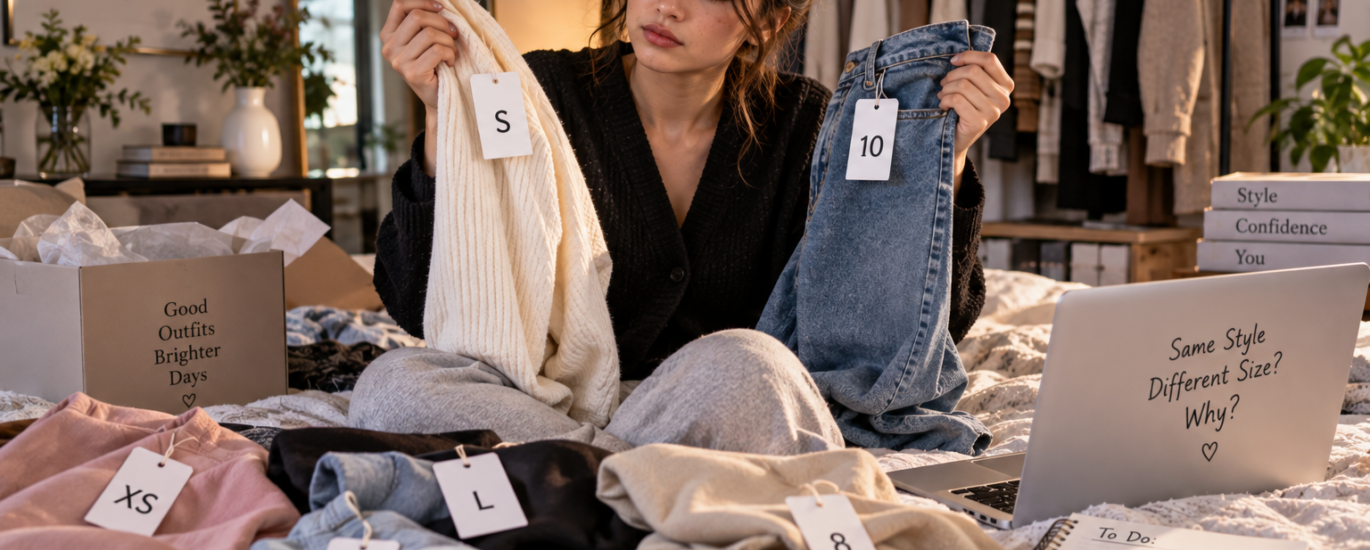
You’re a Size 6 in One Store and a Size 10 in Another—So Which One Is Actually Your Size?
You walk into one store and a size 6 fits perfectly.
Twenty minutes later, you try on a similar pair of pants somewhere else and can barely button a size 8. Then you order another pair online in a size 10, only to discover that it is too loose around the waist.
At some point, the obvious question appears: what size are you actually supposed to be?
The frustrating answer is that clothing sizes are not nearly as standardized as the numbers printed on the labels make them appear.
Understanding why clothing sizes vary between brands can make shopping far less confusing. The number inside a garment is not a universal measurement of your body. It is part of a sizing system created by an individual brand, and those systems can differ significantly.
Clothing Sizes Are Labels, Not Universal Measurements
A number such as 6, 8, or 10 feels precise.
It looks like a measurement.
But unlike centimeters or inches, clothing size numbers do not represent one universally agreed set of body dimensions.
One brand may design a particular size around one set of waist, hip, and bust measurements, while another uses different measurements for a label carrying exactly the same number.
That means two garments marked “Medium” can have noticeably different dimensions.
Neither label is necessarily incorrect.
They are simply using different sizing systems.
Brands Design Around Different Fit Models
Clothing companies do not all design for exactly the same body proportions.
During product development, brands often work from fit models, measurement specifications, historical customer data, and their intended market.
Those decisions influence how garments are shaped.
One brand might provide more room through the hips. Another may design trousers with a narrower waist. A third may use a longer torso or broader shoulder measurement as part of its standard fit.
This is why you may discover that one brand consistently fits your proportions better than another.
The difference is not always about being “bigger” or “smaller.”
Sometimes the garment is simply shaped differently.
The Same Waist Measurement Can Still Produce a Different Fit
Imagine two pairs of trousers with similar waist measurements.
You might expect them to fit almost identically.
But one has a high rise while the other sits lower on the hips. One uses a straight cut through the leg, while another tapers sharply. One has additional room through the seat.
Those differences completely change how the garment feels.
Fit is three-dimensional.
Reducing it to one measurement ignores how fabric needs to move around the entire body.
That is why knowing only your waist size will not always guarantee a good pair of trousers.
Cut Matters as Much as Size
Consider jeans labeled:
Straight.
Slim.
Relaxed.
Wide leg.
Bootcut.
Even when every pair carries the same numerical size, they are intentionally designed to fit differently.
The same principle applies to dresses, jackets, shirts, skirts, and almost every other garment.
A relaxed shirt is supposed to contain more room than a fitted shirt. An oversized blazer may have significantly different dimensions from a tailored blazer even within the same brand.
Before assuming the size is wrong, consider what silhouette the garment was designed to create.
Fabric Can Completely Change How a Size Feels
Two garments can have almost identical measurements when laid flat but feel very different when worn.
Fabric is one major reason.
A woven fabric with very little stretch generally has less flexibility around the body. A knit fabric or material containing elastane may accommodate movement and body contours more easily.
Fabric weight and drape matter too.
A stiff denim holds its structure differently from a soft stretch denim. A rigid cotton shirt behaves differently from a fluid jersey top.
This is why copying your size from one garment category to another does not always work.
Material changes the relationship between garment and body.
Stretch Can Make Sizing More Forgiving
Stretch fabrics can accommodate a broader range of measurements.
That may make choosing a size easier, but it can also make comparisons confusing.
A pair of stretch jeans might feel comfortable even when its unstretched measurements look smaller than those of rigid denim.
The percentage of stretch fiber alone does not tell the entire story either.
Fabric construction influences how much a material stretches and how effectively it recovers afterward.
When shopping online, checking the fabric composition and product description can therefore provide useful context beyond the size label.
Vanity Sizing Added Another Layer of Confusion
Fashion sizing has changed over time.
One frequently discussed phenomenon is vanity sizing, where garments labeled with a particular numerical size may become larger than garments historically carrying that same size.
The practice is not perfectly uniform across the entire industry, and sizing changes can result from multiple factors. But it helps explain why comparing a modern size directly with the same number from decades ago can be misleading.
A vintage dress labeled with a familiar size may fit much smaller than expected.
The label stayed recognizable.
The dimensions associated with it did not necessarily stay the same.
Vintage Shopping Makes the Problem Obvious
Anyone who regularly shops for vintage clothing learns an important lesson quickly:
ignore the label until you see the measurements.
A vintage garment may use a sizing system that differs substantially from contemporary expectations.
It may also have been altered by a previous owner.
Age, washing, fabric shrinkage, and construction can further influence its current dimensions.
For vintage pieces, actual garment measurements are usually much more useful than assuming a modern size conversion will be exact.
That same habit can improve modern online shopping too.
International Sizes Make Things Even More Complicated
Fashion is sold globally, but sizing systems are not universal.
US, UK, European, Japanese, and other regional size conventions can use different numbers and categories.
Conversion charts help, but even those should be treated as a starting point rather than an absolute guarantee.
A converted size may technically correspond to your usual category while the brand’s actual garment proportions still differ.
Whenever possible, use the specific brand’s measurement chart rather than relying exclusively on a generic international conversion chart.
Small, Medium, and Large Are Not Universal Either
Switching from numbers to letters does not solve the problem.
A Small from one brand can resemble a Medium from another.
Some companies offer deliberately oversized fits. Others run relatively narrow. Unisex garments may follow yet another proportion system.
Even within a single brand, different collections can behave differently.
So “I always wear Medium” is useful as a starting point, but it should not become a rule you feel obligated to follow.
The garment has to fit you.
You do not have to fit the label.
Learn Your Actual Body Measurements
One of the simplest ways to make sizing less frustrating is to know several basic measurements.
For many garments, useful measurements include the bust or chest, natural waist, hips, and inseam.
Depending on what you are buying, shoulder width, sleeve length, rise, or torso length may also matter.
You do not need dozens of measurements stored in a spreadsheet.
A few accurate numbers already provide more information than saying, “I think I’m usually an 8.”
Measure periodically because bodies can naturally change over time.
Measure the Garments You Already Love
This trick can be even more useful than body measurements.
Find a pair of trousers, shirt, jacket, or dress that fits exactly the way you like.
Lay it flat and measure relevant areas.
For trousers, that might include waist, rise, inseam, and leg opening. For a shirt, chest width and length may be particularly helpful.
Now you have a real garment to compare against online measurements.
Instead of asking, “Will their Medium fit me?” you can ask, “How does this garment compare with the shirt I already know fits?”
That is a much more practical question.
Read the Brand’s Size Chart Every Time
It is tempting to skip the size chart when you already know your “usual” size.
That habit is exactly what creates many online-shopping disappointments.
Check the chart for the specific brand.
Better yet, determine whether the chart lists body measurements or actual garment measurements.
Those are not the same thing.
A garment needs additional room in certain areas so you can move and so the intended silhouette can exist. This extra space is often referred to as ease.
Understanding what the chart actually measures prevents incorrect comparisons.
Fit Notes Can Be More Valuable Than the Size Number
Good product pages often provide additional information.
The model’s height.
The size being worn.
Whether the garment is fitted or relaxed.
Whether customers tend to find it true to size, small, or large.
These clues help create a fuller picture.
For example, if a jacket is intentionally oversized and the model is wearing her normal size, you may decide whether you want the intended relaxed silhouette or prefer sizing down for a closer fit.
The goal is not always to find the smallest garment you can physically wear.
It is to achieve the fit you actually want.
Pay Attention to the Most Difficult Area to Fit
Different garments have different critical measurements.
For trousers, someone with a larger hip-to-waist difference may find that fitting the hips first makes more sense, then adjusting the waist if necessary.
For structured jackets, shoulders can be particularly important because major shoulder alterations are more complicated than some other tailoring changes.
For fitted dresses, bust, waist, and hip proportions may all matter.
Instead of demanding that every part of your body correspond perfectly to one size column, identify the area where incorrect fit will create the biggest problem.
Then work from there.
Being Between Sizes Is Completely Normal
Size charts divide continuous human measurements into categories.
Bodies do not.
You can easily have a waist measurement corresponding to one size and hips corresponding to another.
That does not mean your body has unusual proportions.
It means standardized clothing is trying to fit a huge variety of bodies using a limited number of manufactured sizes.
When you fall between two categories, consider the fabric, garment cut, intended fit, and which area needs more room.
Sometimes sizing up makes sense.
Sometimes the stretch and silhouette make the smaller option work better.
There is no universal answer.
Tailoring Exists for a Reason
Ready-to-wear clothing is produced for generalized body measurements.
A garment that fits perfectly everywhere straight from the rack is convenient, but it is not the only definition of a successful purchase.
Simple alterations can transform a garment that fits well into one that fits exceptionally well.
Trouser hems are an obvious example.
Waist adjustments, sleeve changes, and other alterations may also be possible depending on garment construction.
When deciding whether something is worth tailoring, consider the purchase price, fabric quality, how often you will wear it, and the complexity of the alteration.
Do Not Buy a Smaller Size Just for the Label
Sizing can become emotional because fashion culture often treats smaller numbers as inherently better.
That turns a manufacturing label into a judgment.
It is not one.
If a size 10 hangs beautifully while the size 8 pulls across the hips and creates uncomfortable tension, the size 10 is the better-fitting garment.
Nobody looking at the finished outfit knows what number is printed inside the waistband.
They see proportion, drape, movement, and comfort.
Choosing the size that fits is not “giving up.”
It is simply understanding how clothes work.
Do Not Automatically Size Up Either
The opposite habit can create problems too.
Some shoppers consistently choose oversized clothing because they worry about anything feeling fitted.
That can work when an oversized silhouette is intentional.
But automatically adding several sizes may alter shoulder placement, garment length, pocket position, neckline, and overall proportion in ways the designer did not intend.
Again, ignore the emotional meaning of the number.
Try to achieve the silhouette you actually want.
Sometimes that means sizing up.
Sometimes it means staying with the smaller option.
Online Shopping Requires a Different Strategy
In a physical store, you can take three sizes into a fitting room.
Online, incorrect sizing creates returns, delays, and frustration.
Develop a repeatable process instead.
Know your measurements, compare them with the brand chart, examine fabric composition, read fit notes, and compare garment dimensions with pieces you already own.
For unfamiliar brands, be slightly more cautious than when ordering from a company whose sizing you already understand.
After several successful purchases, you begin learning how that brand fits your body.
Keep Notes on Brands You Buy Frequently
You do not need a complicated wardrobe database.
A note on your phone can be enough.
Perhaps one brand’s trousers fit you best in a particular size but its jackets require another. Maybe a certain denim cut works perfectly while another consistently feels tight through the hips.
Recording these patterns saves time.
It also prevents the classic mistake of forgetting why you returned something six months ago and ordering exactly the same size again.
Your personal sizing history can be more useful than generic advice online.
Returns Can Teach You Something
An unsuccessful purchase is annoying, but it can provide information.
Instead of simply writing “didn’t fit,” identify what went wrong.
Too tight at the shoulders?
Waist fine but hips too narrow?
Rise too short?
Sleeves too long?
Fabric less stretchy than expected?
Those observations make the next purchase more accurate.
Eventually, shopping becomes less about guessing a size and more about understanding garment construction relative to your own proportions.
Your Body Is Not the Inconsistent Part
This may be the most useful mindset shift.
If three brands give you three different size labels on the same afternoon, your body did not dramatically change between stores.
The sizing systems changed.
Once you understand why clothing sizes vary between brands, inconsistent labels become less personal and more practical.
A size is simply information provided by a manufacturer.
Sometimes that information is useful.
Sometimes you need additional measurements to interpret it.
But it is never a verdict on your body.
Conclusion
There is no single answer to “What clothing size am I?” that will work across every store.
Brands build garments using different measurement standards, fit models, cuts, fabrics, proportions, and sizing conventions. International systems and historical changes such as vanity sizing add even more variation.
The best way to navigate those differences is to stop treating the label as the final authority. Learn a few body measurements, measure garments you already love, check each brand’s size chart, understand the intended silhouette, and pay attention to fabric and construction.
Most importantly, choose the garment that fits.
If one store calls it a 6 and another calls it a 10, nothing meaningful about your body changed.
Only the label did.
