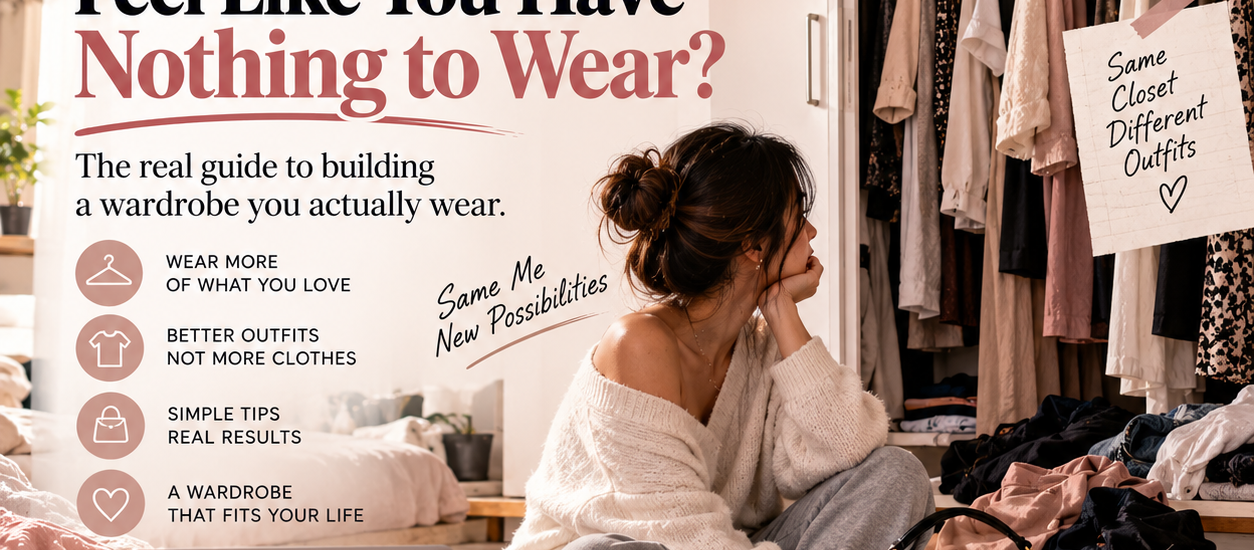
Your Closet Is Full—So Why Do You Still Feel Like You Have Nothing to Wear?
The closet is full.
Not slightly full.
Full.
Shirts squeezed together.
Jeans stacked on top of jeans.
A dress you bought two years ago still has the tag attached.
Three jackets are occupying enough space to qualify as roommates.
Then Saturday arrives.
You need to leave in twenty minutes.
You stand in front of everything and say:
“I have nothing to wear.”
Technically?
Completely false.
Emotionally?
Somehow completely accurate.
This is the strange problem behind learning how to build a wardrobe you actually wear.
The solution is not always buying more clothes.
Sometimes you already have enough clothes.
You just don’t have enough outfits.
Owning Clothes and Having Outfits Are Different Things
Imagine owning 60 individual pieces.
Sounds like plenty.
But what if:
half only work with one specific item,
several don’t fit comfortably,
some belong to a lifestyle you rarely live,
and the rest compete for attention instead of working together?
Your wardrobe can be large while your realistic outfit options remain surprisingly small.
This is why counting clothes tells us very little about how useful a closet actually is.
The Real Test Happens on a Normal Tuesday
Forget weddings.
Vacations.
Birthday dinners.
Special events.
Look at your ordinary week.
Where do you actually go?
Maybe:
work,
coffee shops,
university,
grocery stores,
casual dinners,
the gym,
meetings,
or errands.
Now look at your wardrobe.
Does it mostly support that life?
Or does it support an imaginary version of you who apparently attends rooftop parties four nights a week?
Meet Your “Fantasy Self”
Almost everyone shops for this person occasionally.
Fantasy-you wears:
dramatic coats,
beautiful heels,
complicated layers,
perfectly tailored trousers,
or adventurous colors.
Real-you?
Sneakers.
Comfortable pants.
Simple top.
Out the door.
There is nothing wrong with aspirational fashion.
The problem starts when most of your wardrobe belongs to someone you rarely become.
A Beautiful Piece Can Still Be a Bad Purchase
You see something in a store.
It looks incredible.
You try it on.
Also incredible.
Buy immediately.
Then it enters your closet.
And stays there.
Why?
Maybe it requires:
the right shoes,
specific underwear,
a particular jacket,
perfect weather,
and an event you attend approximately once every 14 months.
A good item is not only something beautiful.
It should also make sense inside your actual wardrobe.
Ask the Three-Outfit Question
Before buying something, ask:
Can I immediately imagine three outfits using pieces I already own?
If yes, good sign.
If your answer is:
“Well, first I need different shoes…”
then:
“Maybe another bag…”
and:
“I probably need pants that work with it…”
your one purchase may secretly be applying for several additional purchases.
Your Closet Needs Connective Pieces
Statement pieces are fun.
But wardrobes also need clothes that connect everything.
Think:
simple tops,
easy trousers,
neutral layers,
reliable denim,
versatile shoes,
basic knitwear.
These pieces may not generate dramatic fitting-room excitement.
But they often create the outfits you wear repeatedly.
Basics Are Not Automatically Boring
A white shirt can look completely different with:
tailored trousers,
jeans,
a skirt,
shorts,
or layered under knitwear.
Simple clothing often gives accessories and statement pieces more room to work.
The point is not turning your entire wardrobe beige.
It is giving the interesting pieces something to cooperate with.
Too Many Statement Pieces Can Create Closet Chaos
Imagine:
printed trousers,
bright patterned shirt,
dramatic jacket,
decorated shoes,
statement bag.
Every piece is interesting.
Together?
Potentially a hostage negotiation.
Statement items become easier to wear when your wardrobe contains enough quieter pieces around them.
Color Compatibility Matters More Than Closet Size
You do not need to wear only neutrals.
But your colors should have some relationships.
Suppose you own ten tops.
Each works with only one specific bottom.
That creates limited combinations.
Now imagine six tops that work with four bottoms each.
Suddenly a smaller wardrobe produces more outfits.
This is why compatibility matters.
Find Your Repeat Colors
Look at the clothes you already wear most.
You may notice recurring colors.
Perhaps:
black,
white,
cream,
navy,
denim,
brown,
gray,
olive,
or another palette.
Those colors are useful information.
They tell you what naturally fits into your existing wardrobe.
Your Personal Palette Does Not Need Rules From TikTok
You do not need to suddenly declare:
“I am officially a Warm Deep Soft Autumn Moonlight Neutral.”
Color analysis can be useful and fun.
But start simpler.
Which colors do you:
enjoy wearing,
feel comfortable in,
and repeatedly combine successfully?
Build from evidence already inside your closet.
Fit Can Be the Hidden Problem
Sometimes you technically have the right clothes.
But you avoid them because something feels slightly wrong.
The waistband is uncomfortable.
The sleeves annoy you.
The shirt constantly needs adjusting.
The dress looks good only when standing completely still.
The shoes become painful after twenty minutes.
Those items count as clothing.
But practically, they barely count as options.
Stop Keeping Clothes That Require Constant Negotiation
You put something on.
Look in mirror.
Take it off.
Try again next week.
Same result.
Again next month.
Same.
At some point, the item has provided enough evidence.
If you consistently dislike how something:
fits,
feels,
moves,
or looks on you,
you do not need to keep conducting the experiment forever.
“Maybe When I Lose Weight” Can Fill an Entire Closet
Bodies change.
That is normal.
Keeping a few meaningful or useful pieces in another size can make sense.
But if half your daily closet consists of clothes you cannot comfortably wear now, getting dressed becomes unnecessarily frustrating.
Your accessible wardrobe should primarily serve the body you are dressing today.
Comfort Is Part of Style
This is easy to underestimate.
If you constantly:
pull down your shirt,
adjust your skirt,
fix your straps,
or worry about your shoes,
the outfit may look great but feel terrible.
Confidence is easier when you can stop thinking about your clothing every thirty seconds.
Photograph Outfits You Love
One morning, everything works.
The proportions.
Shoes.
Jacket.
Accessories.
You think:
“Okay, this is good.”
Take a mirror photo.
Not necessarily for social media.
For yourself.
Create an album called:
Outfits
Now on mornings when your brain refuses to style anything, you have your own reference library.
Your Best Outfit Inspiration May Already Be You
Fashion inspiration online is endless.
But the most useful inspiration often comes from outfits you already wore successfully.
Why?
Because those clothes:
already exist,
already fit,
already match your lifestyle,
and already made you feel good.
That is far more actionable than saving another photo of someone wearing an outfit containing six items you do not own.
Find Your Outfit Formulas
People who seem effortlessly well-dressed often repeat structures.
Not necessarily identical clothes.
Structures.
For example:
wide-leg trousers + fitted top + simple shoes
or:
jeans + T-shirt + structured jacket
or:
dress + light layer + flats
or:
skirt + knit top + boots
These are outfit formulas.
Once you know yours, getting dressed becomes much easier.
Repeating an Outfit Formula Is Not a Fashion Failure
You do not need to invent a completely new silhouette every morning.
If something works, repeat it.
Change:
color,
fabric,
accessories,
shoes,
or outerwear.
Consistency can become personal style.
Pay Attention to Proportions
Sometimes an outfit feels “off” even though every individual item is good.
The issue may be proportion.
A very oversized top with very oversized trousers creates one effect.
A fitted top with wide trousers creates another.
Long outerwear changes the silhouette differently from a cropped jacket.
There is no single correct formula.
The goal is noticing which proportions you personally enjoy.
Tucking a Shirt Can Change the Entire Outfit
Before rejecting an outfit, experiment with styling.
Try:
full tuck,
half tuck,
rolled sleeves,
open layer,
different belt,
different shoe,
or changing where a trouser sits.
Sometimes the clothes are fine.
The styling just needs one small adjustment.
Shoes Can Decide Whether an Outfit Gets Worn
You buy the dress.
Perfect.
Then realize none of your shoes work with it.
Now the dress waits.
Shoes are wardrobe infrastructure.
A few pairs that work across many outfits can make far more clothing wearable.
This is why shoe versatility deserves consideration before adding another pair that works with exactly one look.
Bags Can Have the Same Problem
A beautiful bag that fits nothing you actually carry can become decoration.
Think about real life.
Do you carry:
laptop,
water bottle,
charger,
makeup,
camera,
or almost nothing?
Your bag should support that reality.
Lifestyle beats fantasy again.
Weather Is Part of Your Wardrobe
An outfit can look amazing on Pinterest.
But does it work where you live?
Humidity.
Rain.
Heat.
Cold.
Wind.
All of these affect what you realistically wear.
A useful wardrobe should work with your climate rather than constantly fighting it.
Travel Reveals Your Real Wardrobe Favorites
Packing for a trip creates an interesting experiment.
Suddenly you cannot take everything.
You choose:
the jeans that always work,
the comfortable shoes,
the shirt that matches everything,
the jacket you trust.
Those choices reveal something.
When space becomes limited, you naturally prioritize your most useful pieces.
Pay attention.
Try the Suitcase Test at Home
Imagine you are leaving for one week.
Choose:
five tops,
three bottoms,
two pairs of shoes,
one or two layers.
Could you create enough outfits?
If yes, you may have discovered the core of your wardrobe.
Everything else can build around it.
Shopping Sales Can Create Expensive “Savings”
Original price: $120.
Sale price: $45.
You buy it.
Saved $75!
Except you never wear it.
Actual result:
you spent $45.
Discounts make us evaluate price before usefulness.
Reverse that order.
First:
Would I want this anyway?
Then consider the price.
Do Not Buy Something Just Because It Is “A Good Deal”
A terrible purchase at 70% off remains a terrible purchase.
The closet does not care how impressive the discount was.
It only knows another hanger is occupied.
Trends Should Enter Your Wardrobe Selectively
Trends can make fashion fun.
New shapes.
Colors.
Materials.
Styling ideas.
But not every trend needs participation.
Ask:
Would I like this if I had not seen it 40 times this week?
Can I style it with my existing wardrobe?
Does it suit my actual lifestyle?
Would I still wear it next season?
If yes?
Great.
Trendy Does Not Automatically Mean Temporary
Some trends introduce you to something that genuinely becomes part of your style.
Maybe you discover:
a silhouette,
color,
shoe style,
or accessory
you continue loving long after the trend fades.
The goal is not avoiding trends.
It is separating genuine preference from repeated exposure.
Social Media Can Make Your Wardrobe Feel Older Than It Is
Your clothes did not suddenly become bad.
You just watched 200 videos showing new ones.
Constant exposure to novelty can make perfectly good clothing feel outdated unusually quickly.
Before shopping, spend a week styling what you already own.
You may rediscover pieces you had mentally retired for no reason.
Shop Your Own Closet
Choose one item you rarely wear.
Then challenge yourself to create three outfits around it.
Try different:
layers,
bottoms,
shoes,
accessories.
If nothing works?
Useful information.
Maybe that item truly does not belong in your wardrobe.
But sometimes you discover a combination you simply had never tried.
Put Clothes Where You Can Actually See Them
Clothing hidden behind:
other clothing,
boxes,
overcrowded racks,
or giant stacks
basically disappears.
You forget what you own.
Then you buy something similar.
A less crowded closet makes existing options more visible.
More Storage Is Not Always the Answer
Closet overflowing?
First instinct:
buy organizers.
Boxes.
Extra rack.
Vacuum bags.
Maybe.
But sometimes storage products simply help us store more things we do not use.
Edit first.
Organize second.
Try the Reverse-Hanger Trick
Want to learn what you actually wear?
Turn all your hangers one direction.
After wearing something, return the hanger the opposite way.
After several months, look at what never moved.
This does not automatically mean those clothes must go.
Seasonal and formal clothing naturally gets less use.
But the experiment reveals patterns.
Separate Special-Occasion Clothing
Your wedding-guest dress does not need to compete visually with Monday morning clothes.
Neither does:
ski gear,
formalwear,
costumes,
or highly seasonal clothing.
If possible, separate occasional items from your everyday wardrobe.
Your daily closet becomes easier to read.
Create a Small “Maybe” Box
Decluttering can feel too permanent.
So create a temporary box.
Put uncertain items inside.
Store it away for a month or two.
If you repeatedly think:
“I need that shirt!”
retrieve it.
If you completely forget what is inside?
That tells you something too.
Do Not Declutter Just to Refill the Closet
This happens surprisingly often.
Huge closet cleanout.
Five bags donated.
Beautiful empty space.
Two weeks later:
shopping spree.
Now we are back.
Decluttering works best when paired with understanding why the closet became overloaded in the first place.
Identify Your Shopping Triggers
Do you shop when:
bored,
stressed,
celebrating,
scrolling late at night,
seeing a sale,
planning a vacation?
Shopping can be entertainment.
Nothing inherently wrong with that.
But recognizing the trigger helps you distinguish:
“I genuinely need this”
from:
“I needed something interesting to happen tonight.”
Use a Waiting Period
See something you want?
Save it.
Wait 48 hours.
Or a week for more expensive purchases.
If you still want it and can clearly see how it fits your wardrobe, reconsider.
Many urgent fashion needs mysteriously disappear after Tuesday.
Cost Per Wear Is More Useful Than Price Alone
A $150 jacket worn 100 times costs:
$1.50 per wear.
A $30 top worn once costs:
$30 per wear.
This does not mean expensive automatically equals good.
It means value depends partly on use.
The cheapest item can become the most expensive clothing in your wardrobe if you never wear it.
Quality Matters Most Where You Need It
Not every item needs luxury construction.
Think about where durability matters in your life.
Maybe:
shoes,
work trousers,
outerwear,
bags,
or everyday basics.
Spend more thoughtfully on pieces that receive heavy use.
Save elsewhere.
Take Care of the Clothes You Already Love
A useful wardrobe lasts longer when you maintain it.
Read care labels.
Wash appropriately.
Avoid unnecessary high heat.
Store knitwear properly.
Treat stains quickly.
Repair small problems before they become large ones.
Sometimes the most sustainable new wardrobe is simply keeping your current favorites alive longer.
Learn One Basic Repair
You do not need to become a tailor.
Learn how to:
sew a button,
fix a loose hem,
or handle a tiny repair.
A five-minute fix can prevent a perfectly good item from becoming permanent closet furniture.
Tailoring Can Rescue Almost-Right Clothes
Sometimes an item is good but the fit is slightly wrong.
A tailor may be able to adjust:
length,
waist,
sleeves,
or other details,
depending on the garment.
This can be especially worthwhile for higher-quality pieces you already like.
Stop Waiting for a Completely Finished Personal Style
Personal style changes.
Jobs change.
Bodies change.
Cities change.
Relationships change.
Budgets change.
Taste changes.
The wardrobe that worked at 22 may not fit your life at 30.
That is normal.
Style is not a final exam you eventually pass.
Your Closet Should Evolve With Your Life
Maybe you used to work in an office.
Now you work remotely.
Maybe you moved somewhere warmer.
Started traveling more.
Began attending more professional events.
Changed hobbies.
Your wardrobe should respond.
Otherwise you can end up owning excellent clothes for a life you no longer live.
The Best Wardrobe Is Not Necessarily the Smallest
Minimalism is not mandatory.
If you genuinely love:
fashion,
variety,
color,
collecting,
and experimenting,
a larger wardrobe may suit you.
The goal is not reaching a magical number of items.
It is understanding what you own and being able to use it.
Nor Does Everything Need to Match Everything
A wardrobe does not need mathematical perfection.
You can own weird pieces.
Impractical pieces.
Sentimental pieces.
Clothes you wear twice a year simply because they make you happy.
Fashion is allowed to be emotional.
Just make sure those pieces are additions to a functional wardrobe rather than substitutes for one.
Try This Before Buying Anything New
For the next seven days, photograph every outfit you actually wear.
At the end of the week, look for patterns.
Which:
colors,
shapes,
shoes,
fabrics,
and combinations
keep appearing?
Then ask:
What is genuinely missing?
Maybe the answer is one useful layer.
A pair of shoes.
Better trousers.
Or nothing.
“Nothing” is a surprisingly profitable discovery.
FAQ
Why do I feel like I have nothing to wear when my closet is full?
A large wardrobe can still be difficult to use when items do not coordinate, fit poorly, suit a different lifestyle, or require additional pieces before they become wearable outfits.
How can I make my wardrobe easier to style?
Identify your most-worn colors and silhouettes, create a few repeatable outfit formulas, keep versatile basics available, and photograph combinations you already know work.
What is a wardrobe outfit formula?
An outfit formula is a repeatable clothing structure, such as jeans + simple top + jacket or wide-leg trousers + fitted top. Individual pieces can change while the overall structure remains similar.
How do I know whether I should buy a new clothing item?
Consider whether it fits comfortably, suits your lifestyle and climate, works with several items you already own, and fills a genuine wardrobe gap rather than duplicating something similar.
Do I need a capsule wardrobe?
No. Capsule wardrobes can be useful for people who prefer fewer highly coordinated pieces, but there is no ideal wardrobe size that works for everyone.
How can I stop buying clothes I never wear?
Review your actual outfit habits, identify shopping triggers, use a waiting period before purchases, and ask whether you can create several outfits with the new item using clothes you already own.
Conclusion
Maybe your closet is not empty.
Maybe it is simply crowded with individual pieces that never learned how to work together.
So before buying another top because you have “nothing to wear,” try something different.
Look at what you repeatedly choose.
Photograph the outfits that work.
Notice your colors.
Find your favorite proportions.
Identify your outfit formulas.
Remove the pieces that constantly create frustration.
Then buy only when you understand what is actually missing.
Because a useful wardrobe is not the one containing the most clothes.
It is the one where, when you need to leave in twenty minutes, you can open the door and think:
“Yep. I know exactly what to wear.”
