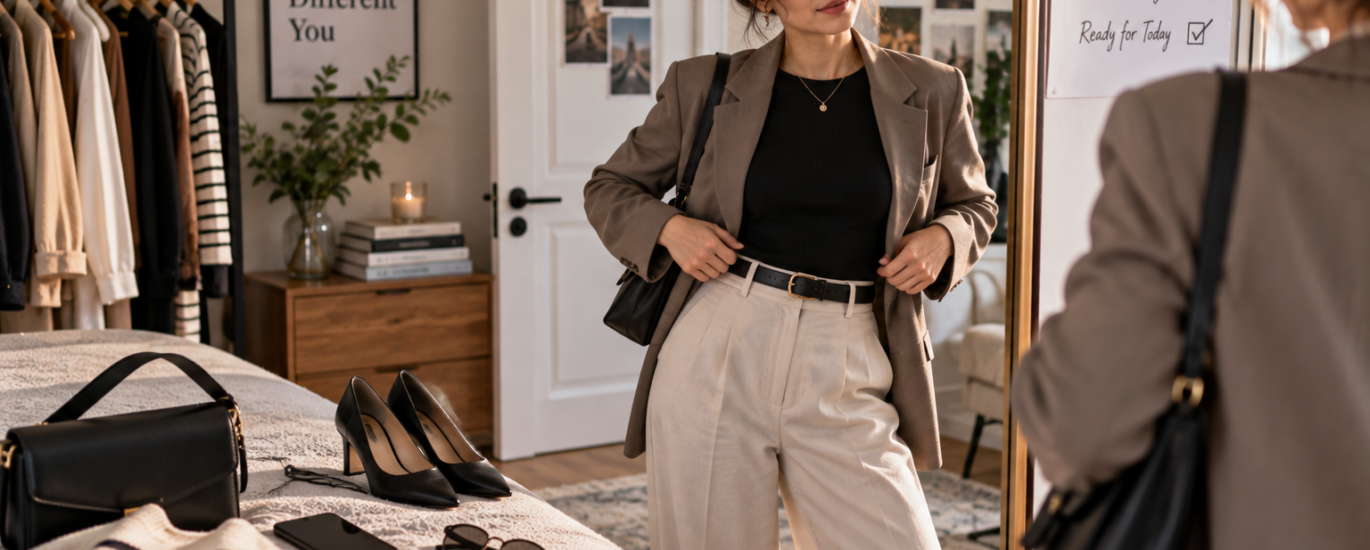
It Looked Perfect in the Mirror—So Why Did the Outfit Feel Wrong the Moment You Left Home?
The outfit looked great before you left.
The proportions seemed right. The colors worked together. The shoes completed the look, and after one final glance in the mirror, you were confident you had made the right choice.
Then real life happened.
You sat in the car and the waistband suddenly felt uncomfortable. The shirt kept moving out of place. The jacket looked good while standing still but became annoying every time you reached for something. Your bag pulled the fabric in a strange direction, and the shoes that looked perfect with the trousers became increasingly difficult to walk in.
By lunchtime, you were adjusting something every few minutes.
This is why learning how to know if an outfit really works requires more than checking whether it looks attractive in a bedroom mirror. Clothes exist on a moving body, in changing light, weather, temperatures, and social situations. A successful outfit has to survive all of them.
A Mirror Shows Only One Version of the Outfit
Most people evaluate an outfit in roughly the same way.
Stand in front of the mirror.
Turn slightly.
Maybe take a photo.
Done.
The problem is that this represents only a few seconds of the outfit’s actual life.
You are standing relatively still, usually in a familiar room, under one type of lighting. Your posture may even change because you know you are looking at yourself.
Once you leave home, those controlled conditions disappear.
Clothes Change When Your Body Moves
A garment does not maintain exactly the same shape throughout the day.
Fabric folds when you sit.
Sleeves move when you raise your arms.
Trousers shift when you walk.
A tucked shirt can slowly escape from the waistband.
A skirt may behave differently on stairs than it does while standing.
The outfit you see in a static mirror is therefore only a starting point.
What matters is how the pieces behave during the activities you will actually perform.
Do the Sit Test Before Leaving
One of the simplest outfit tests requires nothing more than a chair.
Sit down normally.
Do not carefully position every garment first.
Notice what happens.
Does the waistband suddenly dig into your stomach?
Does the shirt pull across the back?
Does the skirt ride much higher than expected?
Do the trousers become restrictive around the hips or knees?
Can you remain seated comfortably for an hour?
An outfit intended for dinner, work, travel, or an event may spend more time sitting than standing.
It should be evaluated accordingly.
Fit Is Dynamic, Not Static
We often talk about fit as though it were one fixed measurement.
“This fits me.”
But a garment can fit beautifully in one position and poorly in another.
A fitted blazer may look sharp with your arms relaxed but feel restrictive when driving.
Trousers can appear perfectly tailored while standing but pull uncomfortably when sitting.
A dress may follow the body beautifully until you try walking quickly.
Good fit is not merely about whether the garment closes.
It is about whether the garment allows the movement required by your day.
Raise Your Arms
This simple movement reveals a surprising amount.
Reach toward a high shelf.
Pretend to put on a coat.
Lift both arms.
Notice whether the entire shirt rises, whether the shoulders become tight, or whether the sleeves restrict movement.
This is particularly useful with structured tops, fitted dresses, blazers, and garments made from fabrics with little stretch.
You do not need gym-level mobility from every outfit.
You do need enough freedom to live normally.
Walk Around the House
Do not take three elegant steps in front of the mirror.
Actually walk.
Move through several rooms. Take stairs if available. Carry your normal bag. Put on the shoes you intend to wear.
Some problems only appear through repetition.
A trouser hem may catch against the shoe.
A skirt may twist.
A shoulder bag may continuously slide.
A jacket may bunch behind a backpack.
These are not necessarily signs that the individual pieces are bad. They may simply be incompatible as a complete outfit.
Shoes Can Change the Entire Silhouette
Changing footwear affects far more than your feet.
Different shoes alter the visual weight at the bottom of an outfit. They can also change how trousers fall, where hems sit, and even how you naturally stand and walk.
Wide trousers paired with a substantial shoe can create a different balance from the same trousers paired with a delicate flat.
A long skirt may clear the ground with one pair and drag with another.
That is why shoes should be included during the outfit test rather than added at the final second.
Hem Length Should Be Tested With the Actual Shoes
This matters particularly for trousers.
A pair can appear slightly too long while barefoot but fall perfectly with the intended footwear.
The reverse can happen too.
Trousers tailored around heels may bunch dramatically when worn with flat shoes.
Instead of deciding that a hem is universally right or wrong, consider the footwear combinations you realistically plan to use.
Versatility sometimes requires compromise.
Your Bag Is Part of the Outfit in Real Life
Fashion photos often treat bags as carefully positioned accessories.
Real bags contain things.
Phone.
Wallet.
Keys.
Water bottle.
Laptop.
Makeup.
Chargers.
The weight changes how the bag hangs and how it interacts with clothing.
A crossbody strap may distort a soft blouse. A shoulder bag may constantly interfere with a structured sleeve. A backpack can crush the back of a blazer.
Test the outfit with the bag loaded approximately as it will be during the day.
Outerwear Can Ruin a Perfect Indoor Outfit
An outfit might look fantastic until you remember that it is cold outside.
Now a coat needs to fit over it.
Suddenly the dramatic sleeves will not fit comfortably. The blazer underneath creates too much bulk. The long coat and skirt compete at the hem.
In colder seasons, outerwear is not an optional afterthought.
For much of the day, it may be the most visible garment you wear.
Build the outfit with that reality in mind.
The Same Applies to Hot Weather
A layered outfit can look sophisticated inside an air-conditioned room.
Then you walk outside.
Within ten minutes, every extra layer becomes something you want to remove.
The remaining outfit may no longer make sense without the jacket or overshirt that originally tied everything together.
When planning what to wear, consider what the outfit looks like after the removable layers are actually removed.
A practical outfit should still function in its likely real-world configuration.
Fabric Determines How an Outfit Behaves
Two garments with nearly identical cuts can perform completely differently because of fabric.
Some fabrics hold structure.
Others collapse softly.
Some stretch.
Others barely move.
Some wrinkle immediately when you sit.
Others recover surprisingly well.
This affects both comfort and appearance throughout the day.
Understanding fabric behavior is often more useful than judging clothing solely by how it looks on a hanger.
Wrinkles Are Not Automatically a Problem
Certain fabrics naturally crease.
Linen is an obvious example.
Trying to keep linen perfectly smooth all day can become an exhausting battle against the material itself.
The better question is whether the wrinkles look natural for the garment and context.
Some clothing looks better slightly lived-in than obsessively pristine.
Expecting every fabric to behave like wrinkle-resistant synthetic material can lead to unnecessary frustration.
But Test Severe Creasing Before an Important Event
There is a difference between natural texture and a garment that looks dramatically different after ten minutes of sitting.
If you are choosing an outfit for an interview, wedding, presentation, or long formal event, sit in it before the actual day.
Stand again.
Look at the fabric.
If the trousers develop heavy creases exactly where you dislike them, at least you know in advance.
Realistic expectations are part of good styling.
Lighting Changes Color More Than You Think
Your bedroom light is not the world.
Warm indoor bulbs can make cream appear richer, soften certain colors, and change the apparent relationship between pieces.
Natural daylight may reveal that two blacks are noticeably different.
Fluorescent office lighting creates another effect.
Evening restaurant lighting creates another.
If color matching is important, look at the outfit near natural daylight before making the final decision.
Two “Black” Garments May Not Match
Black is not always identical black.
Different dyes, fibers, finishes, and fabric textures reflect light differently.
A faded cotton T-shirt may look softer and warmer beside a deep synthetic black trouser. A satin black skirt reflects highlights differently from matte knitwear.
This does not automatically mean they cannot be worn together.
Sometimes the contrast in texture makes the combination more interesting.
The important thing is noticing it intentionally rather than discovering it under bright daylight after leaving home.
White Has the Same Problem
Bright white.
Warm white.
Cream.
Ivory.
Off-white.
These shades can look almost identical separately and surprisingly different when placed next to each other.
Again, this is not necessarily a styling mistake.
Tonal outfits can look sophisticated precisely because they use several related shades.
But if you are trying to create a perfectly matched set, daylight is your friend.
A Phone Camera Can Reveal Different Problems Than a Mirror
Taking a quick photograph can be useful because a camera flattens the outfit differently from your eyes.
You may notice proportion, color balance, or bunching that escaped attention in the mirror.
But do not treat the phone camera as an absolute judge.
Lens distortion, camera height, distance, and lighting can significantly alter how proportions appear.
A strange photo does not automatically mean the outfit looks strange in person.
Use photographs as one source of information, not a verdict.
Video Is Even More Useful for Movement
If you are unsure about a dress, trousers, or a formal outfit, record a short video.
Walk toward the camera.
Turn.
Sit.
Stand.
Move naturally.
This shows how the clothing behaves instead of freezing it at the most flattering second.
You may discover that a garment you thought was awkward actually moves beautifully.
Or that a perfect mirror outfit requires constant adjustment.
Constant Adjustment Is Valuable Information
Pay attention to your hands.
Are you repeatedly pulling the skirt down?
Retucking the shirt?
Moving the neckline?
Fixing a strap?
Straightening the jacket?
Adjusting the waistband?
One adjustment is normal.
Doing it every few minutes suggests the outfit may demand too much attention.
Clothes should generally allow you to participate in your day rather than continuously manage them.
Comfort Does Not Mean Everything Must Be Oversized
There is a false choice in fashion:
Look polished or feel comfortable.
You can often have both.
Comfort depends on appropriate fit, fabric, construction, footwear, temperature, and activity—not simply wearing the loosest possible garment.
A tailored trouser with enough room in the right places may feel more comfortable than oversized jeans that constantly slide.
The goal is functional comfort, not one specific silhouette.
A Slightly Loose Garment Can Still Be Restrictive
Garment size does not tell the entire story.
A shirt may look loose through the torso but have narrow armholes.
Trousers can have plenty of room through the legs while the waistband feels rigid.
A coat can look oversized but restrict the shoulders because of its construction.
Evaluate the areas involved in movement instead of judging comfort from overall visual volume.
Underwear Can Change the Fit
An outfit tested with one bra or undergarment may sit differently with another.
This is particularly relevant for fitted tops, dresses, sheer fabrics, and garments with specific necklines.
The goal is not to follow arbitrary rules about what should or should not be visible.
It is simply to test the complete combination you actually intend to wear.
Small foundational changes can alter how the outer garment hangs.
The Same Is True for Socks and Hosiery
Shoes that feel fine with thin socks may become tight with thicker ones.
A skirt may move differently with tights.
Trousers can cling differently depending on fabric combinations and static.
These details sound minor until you are already outside and cannot easily change them.
An outfit test works best when it includes the boring practical pieces too.
Consider What You Will Actually Be Doing
“Going out” is not an activity.
Are you walking for two hours?
Sitting through dinner?
Standing at a concert?
Driving?
Dancing?
Working at a desk?
Moving between hot streets and cold indoor spaces?
An outfit should be judged against its job.
The same dress can be excellent for one situation and irritating for another without anything being inherently wrong with it.
Occasion Matters More Than Internet Rules
Online styling advice often presents clothing rules as universal.
Never combine this.
Always wear that.
This proportion is flattering.
That shoe is outdated.
Real life is more contextual.
An outfit for a creative workplace has different requirements from one for a conservative business environment. A holiday outfit does not need to solve the same problems as an airport outfit.
Style becomes easier when you dress for an actual life rather than an abstract set of rules.
Do a Pocket Test
If the garment has pockets, use them.
Put your phone inside.
Add keys if that is what you normally carry.
Does the garment sag?
Does the phone create an obvious outline?
Can you sit comfortably?
Some pockets are decorative in practice even when technically functional.
Knowing that before leaving prevents you from building your entire carrying strategy around them.
Check Sheerness in Stronger Light
A garment can appear completely opaque in a dim bedroom and surprisingly sheer near a window.
If that matters to you, check before leaving.
Look at the garment in brighter natural light or a well-lit space.
This is especially useful with light-colored trousers, skirts, shirts, and summer fabrics.
Again, there is no universal rule that sheer clothing is wrong.
The point is making the choice intentionally.
Test the Outfit From the Back
Most mirrors encourage front-facing evaluation.
But other people see the entire outfit.
Turn around or use a second mirror.
Check whether the jacket bunches, trousers sit as expected, tags are visible, or fabric behaves differently from behind.
You do not need to obsess over every angle.
A quick check simply gives you a more complete picture.
Do Not Forget What Happens When You Sit
This deserves repeating because seated clothing can become almost a different outfit.
A neckline may shift.
A short jacket may rise.
Trousers can tighten.
Fabric gathers around the waist.
A skirt changes length.
If you will spend most of the occasion sitting, the seated version arguably matters more than the standing mirror version.
Formalwear Needs a Longer Test
Special-event clothing is often worn for many consecutive hours.
A wedding guest outfit may involve transportation, ceremony seating, standing, photographs, dinner, and dancing.
Shoes that are tolerable for five minutes in a bedroom may become the dominant subject of your evening after three hours.
Wear important outfits around the house before the event.
You are not trying to recreate the entire occasion.
You are looking for problems while they are still easy to fix.
New Shoes Should Not Debut During the Longest Day Possible
Beautiful shoes can transform an outfit.
They can also transform your personality after six hours of pain.
If possible, test unfamiliar footwear before committing it to an event involving significant walking or standing.
Notice pressure points and stability.
Consider whether you need an alternative pair later.
There is nothing stylish about spending an entire event unable to think about anything except your feet.
Your Backup Plan Can Be Part of the Outfit
Practicality does not need to destroy style.
A light layer can handle unexpected air conditioning.
Compact flats can help during a long formal event if appropriate.
A small umbrella can save a weather-sensitive outfit.
The goal is not to prepare for every imaginable disaster.
It is to anticipate the most likely friction points.
Weather Apps Should Influence Styling
A beautiful outfit designed for imaginary weather is rarely useful.
Check the temperature range, rain probability, wind, and how conditions change throughout the day.
Wind matters for lightweight skirts and loose outer layers.
Rain matters for footwear and fabrics.
Large temperature swings matter for layering.
Fashion does not happen separately from weather.
Ask Whether You Can Forget About the Outfit
This may be the best test of all.
Once dressed, can you stop thinking about your clothes?
A great outfit can attract attention when you first put it on, but then fade into the background while you live your day.
You walk.
Talk.
Eat.
Work.
Laugh.
Sit.
Move.
You are aware that you like what you are wearing without having to supervise it constantly.
That is a powerful sign that the outfit works.
Confidence Is Hard When You Are Physically Distracted
People often talk about confidence as though it comes purely from mindset.
Clothing can influence it in more practical ways.
It is difficult to feel relaxed when you are worried the shirt keeps opening.
Hard to focus during a presentation when your shoes hurt.
Hard to enjoy dinner when the waistband becomes uncomfortable after eating.
Removing physical distractions can make confidence easier because your attention is available for something else.
Do Not Buy for Your Mirror Life
This principle also helps when shopping.
A garment may look spectacular in a fitting room.
But ask where it fits into your real week.
Can you commute in it?
Does it work with shoes you own?
Can you layer it?
Will you tolerate the fabric for several hours?
Does it require constant special handling?
A wardrobe becomes more useful when purchases are evaluated against real routines rather than imagined occasions.
Think in Complete Outfits Before Buying
Suppose you find an unusual skirt you love.
Before purchasing it, mentally build at least two or three outfits using items you already own.
Which shoes?
Which top?
Which outer layer?
Which bag?
If every answer requires another purchase, the skirt may be more expensive to integrate than its price tag suggests.
The best wardrobe additions create combinations rather than isolated problems.
“Almost Works” Often Needs One Practical Change
An outfit that feels wrong does not always need to be abandoned.
Maybe the trousers need different shoes.
The dress needs another bra.
The jacket works better with a smaller bag.
The shirt needs to be partially tucked rather than fully tucked.
The outfit needs a lighter layer because of the weather.
Instead of asking, “Is this outfit good or bad?” identify the exact source of friction.
Specific problems are easier to solve.
Learn Your Personal Friction Points
Different people tolerate different things.
One person hates tight waistbands.
Another cannot stand sleeves that touch the hands.
Someone else dislikes carrying a strap across structured clothing.
Another person is perfectly comfortable in heels but hates heavy earrings.
These preferences are useful information.
You do not need to train yourself to tolerate every fashionable item.
Personal style includes knowing which forms of inconvenience are simply not worth it to you.
Keep Notes on Outfits That Worked
You do not need a complicated wardrobe database.
A photo album is enough.
When an outfit works particularly well, take a quick photo.
Over time, patterns appear.
Maybe you repeatedly prefer relaxed trousers with fitted tops.
Perhaps you feel best in tonal combinations.
Maybe certain shoe shapes work with most of your wardrobe.
Instead of reinventing every outfit from zero, build on combinations already tested in real life.
Also Notice Why an Outfit Failed
A failed outfit can teach more than a successful one.
Was it too warm?
Did the shoes hurt?
Was the bag incompatible?
Did the fabric wrinkle more than expected?
Were you constantly adjusting something?
Did it feel too formal for the setting?
The lesson should be specific.
“This outfit was bad” teaches very little.
“This fitted jacket becomes uncomfortable during long drives” gives you information you can use next time.
Personal Style Is Built Through Feedback
Finding your style is often presented as a discovery.
As though somewhere inside you exists one perfect aesthetic waiting to be uncovered.
In reality, style can develop through repeated feedback.
You wear something.
Notice how it feels.
Change one part.
Try again.
Some combinations become favorites. Others quietly disappear.
Over time, you become better at predicting what will work because you have accumulated evidence from your own life.
The Best Outfit Is Not Always the Most Photogenic One
Some outfits are spectacular for ten seconds in a photograph.
Others are less dramatic but look consistently good for eight hours.
Depending on the occasion, the second category may be far more valuable.
Real-world style has to survive movement, weather, chairs, bags, food, transportation, and time.
A mirror rewards appearance at one moment.
Life rewards clothes that keep working after that moment ends.
A Five-Minute Real-Life Outfit Test
Before leaving home in an unfamiliar combination, spend a few minutes doing what the outfit will need to handle.
Put on the actual shoes and bag.
Walk.
Sit.
Stand.
Raise your arms.
Check brighter light.
Add your coat if needed.
Put your phone in the pocket.
You do not need to inspect yourself obsessively.
You are simply giving the clothes a short rehearsal.
Conclusion
Learning how to know if an outfit really works means evaluating more than its appearance in a mirror. Clothes have to move with the body, respond to sitting and walking, work with shoes and bags, handle the weather, and remain comfortable long enough for you to forget about them.
A beautiful static outfit can still fail in real life if it requires constant adjustment. Meanwhile, a combination that seems simple in the mirror may become a favorite because it works effortlessly across an entire day.
So before rejecting your sense of style because an outfit felt wrong after leaving home, look more closely at what actually happened.
Maybe the colors were fine.
Maybe the proportions were fine.
Maybe you did not need a completely different outfit.
You simply needed to test the one you had somewhere more demanding than a mirror.
