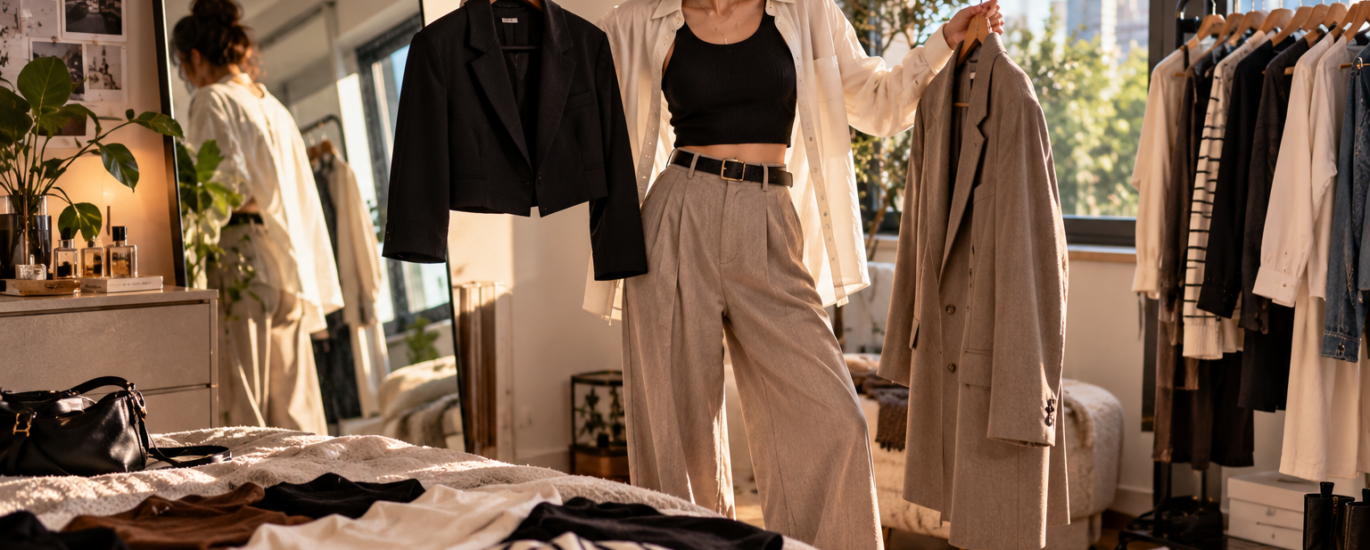
Every Piece Looks Good on Its Own, So Why Does the Outfit Somehow Look Wrong When You Put It All Together?
You know the feeling.
The trousers look great.
The shirt looks great.
The jacket was one of those purchases you were certain would work with almost everything.
The shoes are good too.
Nothing is obviously wrong.
But then you put everything on, look in the mirror, and the outfit somehow feels strange.
Maybe the top suddenly looks too long.
Maybe the trousers feel much wider than they did in the fitting room.
Perhaps the jacket seems to swallow everything underneath it.
So you start replacing pieces.
Different shoes.
Different bag.
Another top.
Maybe some jewelry.
Twenty minutes later, there are clothes all over the bed and the original problem still has not disappeared.
Sometimes the issue is not color, trend, price, or even the individual garments.
It is outfit proportions: the relationship between the lengths, shapes, volumes, and visual weight of everything you are wearing.
Once you begin seeing an outfit as one complete silhouette rather than a collection of separate clothes, getting dressed becomes much easier.
Outfit Proportions Start With the Whole Silhouette
When shopping, we usually evaluate clothes individually.
Does this shirt look good?
Do these trousers fit?
Do I like this blazer?
That makes sense when deciding whether to buy something.
But an outfit is experienced differently.
People do not see four separate product pages walking toward them.
They see one silhouette.
The length of your top affects how the trousers appear.
The width of your trousers changes how the jacket feels.
The position of the waistband influences the apparent relationship between your torso and legs.
Even shoes can change how the bottom of an outfit visually ends.
That is why individually attractive pieces do not automatically create a cohesive outfit.
They still need to work together.
Stop Asking Whether the Clothes Are “Flattering”
Fashion advice has traditionally been full of rules about making bodies look taller, thinner, curvier, or smaller.
That can make proportion sound like another system designed to tell people what they are allowed to wear.
It does not need to work that way.
A more useful question is:
What silhouette am I trying to create?
Maybe you want something long and relaxed.
Maybe sharp and structured.
Maybe oversized.
Maybe compact.
Maybe soft and flowing.
Maybe intentionally dramatic.
There is no requirement that every outfit make your body appear as close as possible to one supposedly ideal shape.
Proportion simply helps you understand what the clothes are doing visually.
Then you decide whether you like the result.
Volume Changes the Visual Weight of an Outfit
Imagine a fitted tank top with wide-leg trousers.
Now imagine the same trousers with an oversized sweatshirt.
The trousers have not changed.
But the second outfit contains much more overall volume.
That changes the silhouette.
Neither combination is automatically wrong.
However, if an outfit feels heavier or more shapeless than expected, look at where the volume is concentrated.
A large coat, wide trousers, chunky shoes, and an oversized sweater can all compete for visual attention.
Sometimes that is exactly the fashion statement you want.
Other times, it is why an outfit that looked effortless in your head suddenly feels overwhelming in the mirror.
Try Balancing Volume Before Replacing the Outfit
One of the simplest experiments is changing only one area of volume.
If the trousers are very wide, try a more compact top.
If the sweater is oversized, compare it with straighter trousers.
If you are wearing a voluminous skirt, see what happens when the top becomes more streamlined.
This is not a law.
Fashion absolutely allows volume on volume.
But balancing one relaxed piece with something more structured is an easy diagnostic tool when you cannot figure out why an outfit feels off.
You can always add more volume again deliberately.
The difference is that now you understand what it changes.
Oversized and Too Big Are Not the Same Thing
This distinction matters.
Oversized clothing is intentionally designed to create volume.
A jacket may have dropped shoulders.
A shirt may have extra width.
Trousers may deliberately pool or drape.
Those details can create a clear silhouette.
Clothing that simply fits poorly behaves differently.
Shoulder seams may fall in awkward places.
Sleeves may accidentally cover the hands.
Fabric may bunch where it should hang.
A waistband may collapse.
An intentionally oversized outfit can look polished.
An incorrectly fitting outfit can simply look accidental.
Before blaming proportion, check the basic fit.
The Waistline Can Completely Change an Outfit
Take the same shirt and trousers.
First, leave the shirt completely untucked.
Then tuck it in.
Nothing else changes.
Yet the silhouette can look dramatically different.
Why?
Because you moved the visible dividing line between the upper and lower body.
A long untucked shirt creates one proportion.
A tucked shirt creates another.
A cropped top creates another.
A low-rise waistband changes it again.
This is why the location of the waist can be such a powerful styling tool.
Try the Tuck Test
When an outfit feels wrong, do not immediately change the top.
Change how you wear it.
Try:
A full tuck.
A small front tuck.
Completely untucked.
Fold the hem inward temporarily.
Then compare.
You may discover that the shirt itself was never the problem.
Its length relative to the trousers was.
This is especially useful when working with wide-leg or high-rise bottoms because small changes around the waist can substantially alter the visual ratio between top and bottom.
The Rule of Thirds Is a Tool, Not a Law
You may have seen fashion advice recommending a one-third to two-thirds visual division.
For example, a shorter top paired with longer trousers can create roughly one-third upper silhouette and two-thirds lower silhouette.
This often feels visually dynamic because the outfit is not divided directly in half.
But do not start measuring yourself with a ruler.
The idea is simply useful for understanding why moving a hemline or waistline can transform an outfit.
A 50/50 division can sometimes feel static.
An uneven division may feel more intentional.
Sometimes you will prefer the opposite.
Use the concept to experiment rather than obey it.
Jacket Length Matters More Than You Think
A blazer can look fantastic with one pair of trousers and strangely heavy with another.
The jacket did not suddenly become ugly.
Look at where it ends.
Does it finish close to the widest part of another garment?
Does it create an awkward horizontal break?
Does a long jacket compete with a long skirt?
Would a shorter outer layer expose more of the lower silhouette?
This is why outerwear can completely alter an outfit even when you leave everything underneath unchanged.
The hemline becomes another visual dividing point.
Long Layers Can Create a Strong Vertical Line
Not every jacket needs to be short.
Long coats and cardigans can create beautiful elongated silhouettes.
The key is understanding what happens underneath them.
A long open coat can create two vertical lines running down the body.
A long closed coat becomes almost the entire silhouette.
A long cardigan over similarly long, loose layers may produce a softer and more voluminous effect.
Again, there is no universally correct option.
The question is whether the lengths look intentional together.
Wide-Leg Trousers Are Often Blamed for the Wrong Problem
Someone buys wide-leg trousers.
At home, they feel overwhelming.
The conclusion:
“Wide-leg trousers don’t suit me.”
Maybe.
But before giving up, change the rest of the outfit.
Try a shorter top.
Try tucking the existing top.
Try a more fitted knit.
Try a different shoe.
Try adjusting where the trousers sit at the waist.
The problem may not be the width of the trousers.
It may be the relationship between that width and everything surrounding it.
Trouser Length Changes the Bottom of the Silhouette
A pair of wide trousers ending above the ankle creates a different visual effect from the same shape nearly touching the floor.
Straight trousers with a clean break feel different from fabric heavily stacking around the shoe.
Cropped trousers expose the ankle and introduce another horizontal line.
None of these is inherently better.
But the length of the trousers affects how the eye travels through the outfit.
If something feels unfinished, check the hem before replacing the entire look.
Shoes Are Part of the Proportion Equation
Shoes can appear like a small detail.
Visually, they are the ending point of the outfit.
A delicate shoe under extremely wide trousers creates one effect.
A chunky sneaker creates another.
A tall boot continues the lower-body line differently from an ankle-baring shoe.
A pointed toe can extend the visual line.
A thick sole adds weight at the bottom.
That does not mean you need a different shoe for every trouser.
It means shoes should be evaluated as part of the silhouette rather than added only after the “real” outfit is finished.
Look at Where the Eye Stops
An outfit contains visual breaks.
A belt.
A jacket hem.
The end of a shirt.
The top of a boot.
A contrasting sock.
A cropped trouser.
A strong color change.
Each can interrupt or redirect the eye.
Sometimes several horizontal breaks close together make an outfit feel visually busy.
Other times, one strong break creates exactly the structure the look needed.
If you cannot identify what feels strange, look for those stopping points.
Color Can Change Perceived Proportion Too
Two garments with identical shapes can feel different depending on color.
High contrast makes boundaries easier to see.
Imagine a white top with black trousers.
The separation between them is obvious.
Now imagine a dark charcoal top with black trousers.
The boundary becomes softer.
This can make the silhouette feel more continuous.
Neither approach is better.
Contrast simply gives you another way to control how clearly different sections of the outfit are perceived.
Monochrome Does Not Have to Mean Boring
A mostly monochromatic outfit can simplify proportion because strong color breaks are reduced.
But it does not have to look flat.
You can introduce variation through texture.
Knit against denim.
Cotton against leather.
Matte against subtle shine.
Structured against fluid fabric.
Different shades within the same color family can also create depth without cutting the silhouette into obvious sections.
This can be especially useful when the shapes themselves are already dramatic.
Texture Has Visual Weight
A chunky cable-knit sweater usually looks visually heavier than a thin fitted knit.
A stiff denim jacket carries more structure than a soft cardigan.
Heavy wool trousers behave differently from fluid trousers even if their measurements are similar.
This means proportion is not only about centimeters.
Fabric matters.
Texture matters.
Drape matters.
A piece can occupy the same physical space but communicate a completely different amount of visual weight.
Structure Can Anchor Soft Pieces
If everything in an outfit is soft, flowing, and loose, you may love the relaxed result.
But if it feels less intentional than expected, add one structured element.
Maybe a tailored jacket.
A firmer bag.
A belt.
A more defined shoe.
Structured trousers.
You are not trying to make the entire outfit formal.
You are simply introducing contrast.
Often, one clear element is enough to give softer pieces something to work against.
Accessories Can Be Too Large or Too Small for the Outfit
Imagine a dramatic oversized coat paired with a tiny delicate bag.
That contrast might look fantastic.
Or the bag might visually disappear.
Now imagine a huge tote with an already voluminous outfit.
It might reinforce the oversized aesthetic.
Or it may add more weight than you wanted.
Accessories have proportion too.
Large earrings, scarves, bags, sunglasses, necklaces, and belts all occupy visual space.
If an outfit feels overloaded, removing one accessory may do more than changing the clothes.
One Focal Point Can Simplify Everything
When every item is demanding attention, the outfit can become difficult to read.
Patterned trousers.
Statement shoes.
Large jewelry.
Bright bag.
Dramatic jacket.
Interesting top.
None of these pieces is necessarily bad.
But together, they may compete.
Try choosing what you want noticed first.
If the jacket is the star, allow some other elements to become quieter.
If the shoes are the point, give them visual room.
A clear focal point can make complicated outfits feel deliberate.
Simple Outfits Depend Heavily on Proportion
A white T-shirt and jeans sound almost impossible to get wrong.
Yet the same basic formula can produce dozens of different silhouettes.
Oversized tee with slim jeans.
Fitted tee with wide denim.
Cropped tee with high-rise straight jeans.
Long tee with relaxed low-rise denim.
Boxy tee with cropped jeans.
Same categories.
Completely different outfits.
When an outfit has very few pieces, cut and proportion become even more visible because there is less decoration to distract the eye.
Basics Are Not Actually Neutral
We often describe basics as though they have no personality.
But every basic has a shape.
A T-shirt can be fitted, boxy, long, cropped, thick, thin, structured, or draped.
Jeans can be skinny, straight, barrel, bootcut, wide, cropped, or relaxed.
A basic blazer can be sharp and waist-defined or oversized and soft.
So buying “good basics” is not enough.
The shapes of those basics need to work with the silhouettes you actually like wearing.
This Is Why Copying an Outfit Can Fail
You save a look online.
You own almost every equivalent piece.
You recreate it.
Something is wrong.
It is tempting to think the original person simply has the “right body” for the outfit.
But first compare the garments more carefully.
Maybe their jacket ends higher.
Their trousers have a higher rise.
Their sweater is shorter.
Their jeans are fuller.
Their shoes have more visual weight.
The colors may be similar while the proportions are completely different.
When using inspiration, copy relationships rather than merely categories.
Ask What the Outfit Is Doing, Not Who Is Wearing It
Instead of:
“I can’t wear that.”
Try:
“What makes that silhouette work?”
Maybe the top is short relative to the trousers.
Maybe the coat and trousers create one long line.
Maybe a fitted base layer allows an oversized jacket to dominate.
Maybe the shoe echoes the volume of the trousers.
Once you identify the relationship, you can recreate the idea using pieces suited to your own wardrobe and preferences.
That is far more useful than trying to reproduce an outfit item for item.
Photos Can Reveal What the Mirror Does Not
Sometimes an outfit looks fine in the mirror but strange in a photo.
Or the opposite.
A photograph compresses the outfit into a flat composition, making lengths and visual breaks easier to notice.
If you are unsure about a look, take a simple full-body photo.
Then look at the silhouette.
Where does the top end?
Where is the waist?
Where does the jacket end?
How wide is the upper half compared with the lower half?
Which item attracts attention first?
You may spot the issue immediately.
Compare Two Versions Instead of Judging Yourself
This is important.
Do not take a photo and ask:
“Do I look bad?”
That question is too broad and often becomes unnecessarily personal.
Instead, create two versions.
Top tucked versus untucked.
Different jacket length.
Different shoe.
Sleeves pushed up versus down.
Belt versus no belt.
Then compare the outfits.
Now you are evaluating styling decisions rather than evaluating your body.
Rolling a Sleeve Can Change More Than You Expect
Tiny styling adjustments can change proportion.
Push blazer sleeves slightly upward and more of the forearm becomes visible.
Roll a shirt sleeve and the upper half may feel lighter.
Open a few buttons and the neckline changes.
Tuck only one side of a shirt and the hem becomes asymmetrical.
These changes cost nothing.
Before buying another item to fix an outfit, experiment with the one already on your body.
Layering Works Best When Each Layer Has a Job
Layering can make an outfit interesting.
It can also make it visually confusing.
Suppose you wear:
A long shirt.
A cropped sweater.
A mid-length jacket.
A scarf.
Wide trousers.
Now there are several competing lengths.
That might produce a creative, editorial silhouette.
But if your goal was simple everyday dressing, it may feel unnecessarily complicated.
Ask what each layer contributes.
Warmth?
Color?
Texture?
Shape?
If a layer does none of those things, try removing it.
Cropped Does Not Always Mean Showing Skin
People sometimes avoid cropped proportions because they do not want exposed skin.
But cropped simply describes where a garment ends.
A cropped jacket can be worn over a longer layer.
A short sweater can meet the waistband of high-rise trousers.
A shirt can be temporarily folded inward.
You can create a shorter upper proportion without exposing the midriff.
The styling principle and the amount of skin shown are separate decisions.
Belts Are Visual Lines, Not Just Functional Accessories
A belt can hold trousers in place.
It can also create a strong horizontal break.
A contrasting belt draws attention to the waist.
A belt close in color to the trousers creates a subtler division.
A wider belt has more visual weight than a narrow one.
If an outfit lacks structure, a belt can introduce it.
If the outfit already contains many visual breaks, another strong line may be unnecessary.
Use the belt because it improves the composition, not because an outfit formula says you must.
Your Bag Can Continue or Interrupt the Silhouette
Crossbody straps create diagonal lines.
Shoulder bags add volume near the upper body or hip depending on their length.
Large totes add substantial visual weight.
A small handheld bag behaves differently.
Try adjusting the strap length of a bag you already own.
You may find that the same bag suddenly works better simply because it sits at a different point on the body.
That is proportion again.
No new purchase required.
Personal Style Becomes Easier When You Know Your Favorite Silhouettes
Instead of collecting endless fashion aesthetics, start noticing repeated shapes in outfits you love.
Maybe you repeatedly choose:
Wide trousers with compact tops.
Straight jeans with oversized jackets.
Long skirts with simple fitted knits.
Loose shirts with tailored trousers.
Monochrome columns with long outerwear.
Those patterns are useful.
They tell you more about your actual style than a list of trendy labels.
Create Three or Four Reliable Silhouette Formulas
You do not need dozens.
A few combinations can become the foundation of your wardrobe.
For example:
Compact top + wide bottom.
Relaxed top + straight bottom.
Simple base + oversized outer layer.
Long continuous silhouette + one strong accessory.
The exact formulas should come from your own clothes.
Once you know them, shopping becomes easier because you can ask where a new piece fits.
A Beautiful Item Is Not Automatically a Useful Item
This is one of the biggest wardrobe traps.
You find a beautiful oversized jacket.
You love it.
But most of your trousers are also extremely wide and most of your tops are long.
The jacket may be great while still being difficult to integrate into your existing silhouettes.
Before buying, imagine at least three complete outfits.
Not:
“What colors match this?”
Instead:
“What shapes in my wardrobe work with this?”
That question can prevent many purchases that become permanent closet decorations.
Shop for the Missing Relationship
Sometimes your wardrobe does not need “more clothes.”
It needs one specific proportion.
Maybe you own several wide trousers but almost no shorter tops.
Maybe every jacket you own is long.
Maybe all your skirts are voluminous and most of your sweaters are equally oversized.
The wardrobe has plenty of pieces, but limited relationships between them.
Identifying that gap makes shopping much more intentional.
Tailoring Can Solve Problems Shopping Cannot
Sometimes you already own the right garment.
It is simply slightly too long.
A trouser hem pools awkwardly.
A blazer sleeve covers too much of the hand.
A skirt ends at a length you never enjoy.
Small alterations can change how the entire garment interacts with the rest of your wardrobe.
Before replacing a quality item, consider whether the proportion—not the garment itself—is the problem.
Trends Can Distort Your Eye Temporarily
Fashion proportions change over time.
After years of seeing skinny jeans, wide trousers can initially feel enormous.
After oversized blazers dominate fashion, a fitted jacket can suddenly feel unusually small.
Our eyes adapt to familiar silhouettes.
That is why “this looks weird” does not always mean “this looks bad.”
Sometimes it simply means:
“I am not used to seeing myself in this shape.”
Give unfamiliar silhouettes a little time before deciding.
You Do Not Have to Follow Every Proportion Rule
Perhaps you love oversized shirts with oversized trousers.
Wear them.
Maybe you enjoy very long tops over long skirts.
Great.
Maybe you prefer everything fitted.
Also valid.
Understanding outfit proportions is not about reducing fashion to mathematical formulas.
It is about knowing what creates an effect so you can choose that effect intentionally.
Breaking a rule deliberately is completely different from feeling confused about why an outfit is not doing what you expected.
Comfort Is Part of a Successful Proportion
An outfit can look incredible while standing perfectly still.
But can you sit?
Walk?
Reach?
Carry your bag?
Spend six hours wearing it?
Real personal style happens in movement.
If you constantly pull down the top, adjust the waistband, or reposition the jacket, the outfit may not work for your actual life.
A silhouette should not only look intentional.
It should function.
Start With What You Already Own
You do not need a wardrobe overhaul.
Choose one pair of trousers you wear frequently.
Try it with three different top lengths.
Then add two different jackets.
Try different shoes.
Take photos.
Notice what changes.
Repeat the experiment with a skirt or jeans.
Very quickly, you will start recognizing the combinations you naturally prefer.
That knowledge is far more valuable than another list of clothes everyone supposedly needs.
The Goal Is to Understand Your Eye
Eventually, you may stop consciously thinking about thirds, volume, break points, and visual weight.
You will simply look at an outfit and know:
The jacket needs to be shorter.
The top should be tucked.
The trousers need a different shoe.
The bag should sit higher.
The sweater needs more structure.
That instinct is not mysterious.
It develops through observation.
The more deliberately you compare outfits, the easier proportion becomes to recognize.
Conclusion
When every garment looks good individually but the complete outfit somehow feels wrong, buying another piece is not always the solution.
Look at the outfit proportions first.
Notice where each garment begins and ends. Look at how much volume exists on the upper and lower body. Check the waistline, jacket length, trouser hem, shoes, accessories, texture, and the visual breaks created by contrasting colors.
Then experiment.
Tuck the shirt.
Push up the sleeves.
Change the shoe.
Remove one layer.
Adjust the bag strap.
Try a shorter jacket.
Take a photo and compare two versions.
You may discover that your wardrobe was never missing better clothes.
It was missing better relationships between the clothes you already had.
And once you understand those relationships, getting dressed stops feeling like trying random pieces until something works.
You begin building the silhouette on purpose.
